Ti-Star Project

Development of New Titanium Alloys with Reduced Susceptibility to Hydrogen Embrittlement

Quick Overview

A high level of interest in new, environmentally friendly propulsion technologies inevitably leads to a significant demand for H2 supply systems. By developing new titanium alloys that are better suited for use in hydrogen-containing environments, the Ti-Star research project supports the introduction of all kinds of innovative propulsion systems.

Given the excellent specific properties of titanium materials, it is desirable to use them in hydrogen-containing environments in the mobility sector. However, contact with hydrogen can lead to the formation of a brittle hydride phase, which causes premature failure and is generally known as hydrogen embrittlement of titanium materials. As a result, the use of currently known titanium alloys such as Ti-6Al-4V has been severely limited.

This is where the project comes in, investigating the influence of specifically selected alloying elements on the behavior of titanium materials under hydrogen conditions, with the goal of developing a novel alloy for the applications described, which will enable the Hanseatische Warenhandelsgesellschaft to expand its product portfolio and tap into new markets. A promising approach to reducing the material’s susceptibility to hydrogen embrittlement is the incorporation of other hydride compounds that have a less embrittling effect and, due to their higher affinity, prevent the formation of titanium hydrides.
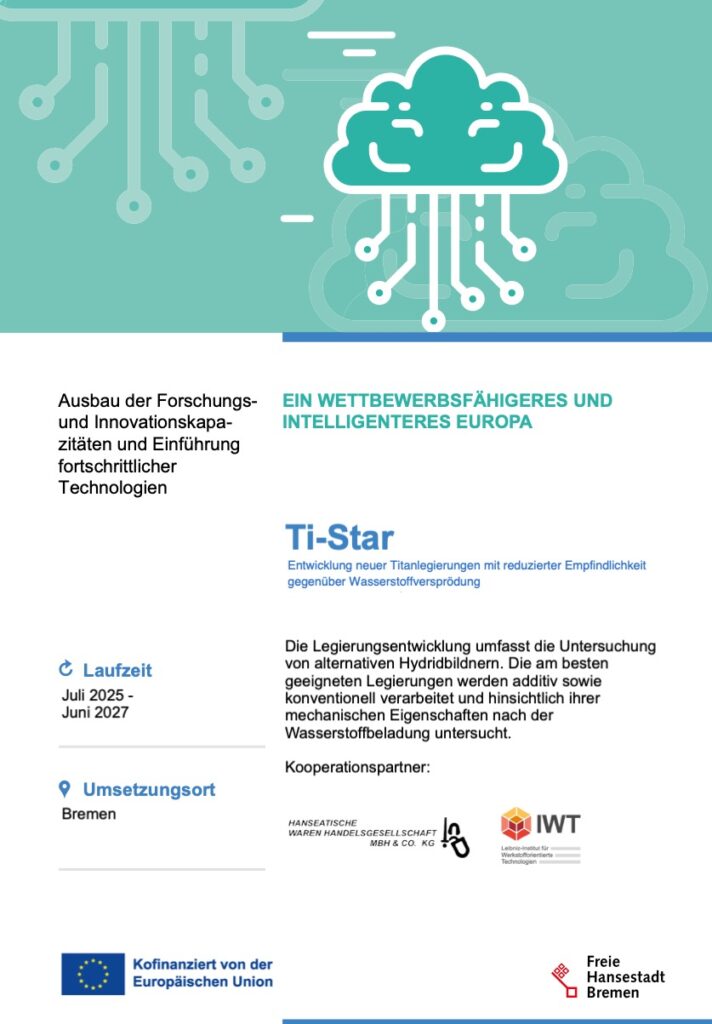
Runtime
01/07/2025 – 30/06/2027
Project Manager
Patrick Voigt, Ph.D. (Eng.)
Project sponsor
Bremer Aufbau-Bank GmbH
Grant Reference Number
65015468

TiStar Project Poster
Space for Innovation: Poster with an overview of the ERDF-funded Ti-Star project

Using the Thermo-Calc simulation software, it is possible to analyze phase diagrams and key properties—such as hydrogen solubility in different microstructures as a function of various alloying elements, phase fractions, and transformation temperatures of specific phases. This digitization of development processes enables the targeted investigation of promising alloy compositions in practice. This conserves raw materials and energy resources, which in turn contributes to a reduction in CO2 emissions as part of sustainable development.

To investigate the influence of the alloying elements, the selected alloys are smelted by the Hanseatische Warenhandelsgesellschaft. The innovative process principle makes it possible to produce a wide range of alloy compositions and represents a unique selling point in the production of specialty alloys.

Ti-Star supports regional development in Bremen by drawing on and further developing its existing expertise in titanium, titanium processing, and alloy development. Additional expertise is being developed in forward-looking areas such as „New Aviation“ and digitalization. The local supply chain improves the availability of titanium materials as critical raw materials.